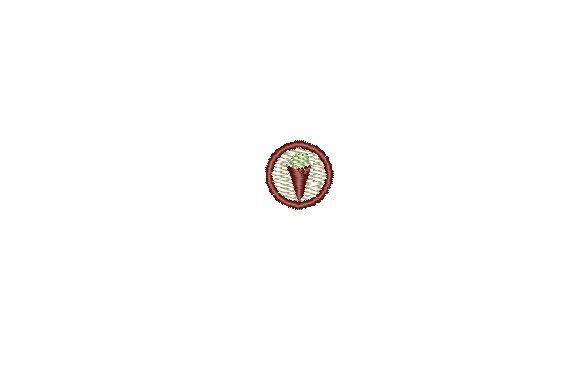
Ice Cream Cone Miniature
A Sweet Spot for Small-Scale Charm
First glance at Ice Cream Cone Miniature is pure delight—compact, cheerful, and instantly legible. It’s not trying to be a statement piece; it’s a whisper of summer nostalgia, rendered in mint green scoop and warm-toned cone against an off-white background. The satin stitch outline gives it clean definition without heaviness, and the miniature scale means it breathes easily on fabric instead of dominating it. This isn’t a dessert-themed filler—it’s a design with personality, restraint, and quiet confidence.
Where It Shines: Real Projects, Real Customers
I recently used Ice Cream Cone Miniature on a set of linen tea towels for a local café’s weekend pop-up. Stitched at 2.1" tall on the lower corner, it landed perfectly—not too cute, not too literal, just warmly human. Customers paused to smile, point, and ask where the towels were made. That’s the quiet power of this design: it elevates everyday handmade product without shouting. It works equally well on baby onesies (paired with soft pastel thread), unisex sweatshirts (centered above the pocket), or embroidered patches sewn onto denim jackets. For Etsy sellers, it’s a strong candidate for seasonal listings—think “summer gift bundle” or “nursery decor starter set.” As a boutique branding accent, it adds approachable sweetness to aprons, tote bags, or even kitchen towel sets sold as curated small shop products.
What It Doesn’t Try to Be (and Why That’s Smart)
Ice Cream Cone Miniature avoids over-detailing—a smart call for a miniature machine embroidery design. There’s no tiny cherry, no swirl texture on the scoop, no shadowing or gradient fill stitch that could blur at small scale. Instead, it leans into shape, contrast, and confident satin stitch framing. That makes it forgiving across fabric types and ideal for beginners testing their first commercial embroidery project—or seasoned designers streamlining production. It also translates cleanly into printable mockups: whether you’re previewing it on a light cotton tee or a dark organic sweatshirt, the mint/off-white palette holds up. Just remember to test thread color contrast—mint can mute on heather grey or olive fabrics, so a slightly brighter mint or pale sage may read better than the default digitized tone.
Stitching Smarter, Not Harder
This design performs best when treated like a precision tool—not a one-size-fits-all asset. Here’s what I check every time:
- Stabilizer matters more than usual. Because it’s miniature and relies on crisp satin stitch definition, lightweight cutaway or tear-away works better than basic fusible on knits or textured weaves.
- Hoop size is non-negotiable. Don’t force it into a 3x3 hoop if your file suggests 4x4 minimum—crowding distorts satin stitch tension and risks skipped stitches near the cone’s curve.
- Test on scrap fabric first—especially stretchy or napped surfaces. On baby rib knit, I added a light topping stabilizer to keep the mint fill stitch from sinking between ribs. On terry cloth towels, I reduced top thread tension slightly to prevent puckering around the satin outline.
- Review stitch density before scaling. If you enlarge Ice Cream Cone Miniature beyond its intended range, fill stitch areas can become dense and stiff—fine for a wall hanging, less ideal for a baby bib meant for frequent washing.
Fabric & Fit: Know Its Boundaries
It sings on smooth, stable fabrics: midweight cotton twill, quilting cotton, linen blends, and pique polo knit. It’s less forgiving on ultra-thin voile (stitch show-through) or highly curved surfaces like structured caps—where the satin stitch outline can distort unless hooped with precise underlay. Dark fabric? Yes—but confirm your off-white background isn’t digitized as “no-fill” (which leaves raw fabric showing). If it is, add a white underlay layer in your software or choose a version with built-in backing. And while it’s lovely on nursery decor, avoid placing it near seams or high-friction zones on toddler clothing—the satin edge holds up well, but repeated folding and washing will soften sharpness over time.
Commercial Use: Trust, Clarity, and Quiet Professionalism
As a designer who supplies embroidery files to small craft businesses, I look for assets that reflect well on *their* brand—not just mine. Ice Cream Cone Miniature delivers that. Its clean lines and balanced proportions signal attention to detail, which builds customer trust in handmade product listings. When an Etsy seller uses it on a personalized gift (“Emma’s First Summer” embroidered on a sunhat), the design feels intentional—not clip-art casual. That perception lifts perceived value. It also integrates smoothly into cohesive collections: pair it with simple lemon slice or cupcake miniatures for a dessert-themed digital embroidery file bundle. Just verify licensing terms before reselling the finished product or bundling it as part of a commercial embroidery kit.
Final Thought: A Design That Earns Its Place
Not every embroidery file earns repeat use. Ice Cream Cone Miniature does—because it solves real problems: it reads clearly at small scale, stitches reliably across common substrates, supports both personal joy and professional presentation, and fits naturally into broader creative workflows—from holiday embroidery planning to boutique branding refreshes. It’s not flashy. It doesn’t need to be. In a market saturated with overdesigned assets, its thoughtful simplicity is exactly what makes it memorable, usable, and quietly essential.