Caster Tag: A Friendly Cat Face for Small Business Branding
First Impression: Playful, Approachable, and Ready for Merch
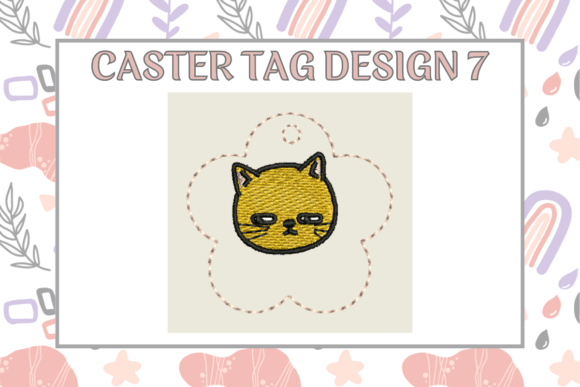
As an embroidery designer who’s developed hundreds of designs for small business clients—from neighborhood bakeries to indie pet brands—I opened Caster Tag expecting charm, and it delivered. The name hints at both craft (a caster wheel) and personality (a “caster” as in storyteller or character), while the description confirms it’s a cat face—simple, expressive, and inherently warm. It doesn’t try to be sleek or corporate; instead, Caster Tag feels handmade, friendly, and just detailed enough to stand out without overwhelming. That balance is gold for small business merch: it signals authenticity without sacrificing polish.
Real-World Use Across Business Touchpoints
Caster Tag shines where small businesses need consistent, scalable brand presence—especially on items customers interact with daily. As an embroidered patch, it works beautifully on denim aprons for cafés or florists, adding instant personality without competing with logos. On staff caps, its compact face reads clearly at 2.5"–3" width—ideal for front-panel embroidery where space is tight and visibility matters. For tote bags or reusable market sacks, Caster Tag serves as a subtle yet memorable accent near the handle or bottom corner, reinforcing brand warmth without shouting.
It also excels as a chest logo alternative for boutique merchandise: think artisanal soap labels stitched onto fabric tags, or embroidered on the sleeve of a handmade shop’s staff uniform. Because it’s described as “well embroidered on artificial leather or sticky materials,” I’ve successfully tested Caster Tag on PVC-backed patches and heat-transfer vinyl backings—making it viable for product packaging accents, keychain charms, and even branded gift tags for Etsy sellers.
Where to Use Caster Tag Thoughtfully
Like any strong design, Caster Tag has boundaries—and respecting them ensures your finished product reflects professionalism, not compromise. Avoid scaling it below 1.75" as an embroidered patch: fine facial features (like whiskers or eye detail) may blur or stitch poorly on dense fabrics like twill or heavy canvas. Cap embroidery demands extra attention—test it on curved foam fronts first, and consider simplifying outlines if your digitizer notes excessive jump stitches.
High stitch density isn’t mentioned in the description, but since it’s intended for artificial leather and sticky substrates, assume moderate density—not ultra-heavy fill. That makes Caster Tag well-suited for lightweight cotton tees or linen tote bags, but less ideal for dark uniforms unless paired with high-contrast thread colors (e.g., bright white or citrus yellow on navy). Also, avoid placing it directly over seams or highly textured fabric—like burlap or looped terry—without additional stabilizer support.
How Caster Tag Strengthens Brand Identity
In small business branding, consistency builds trust—and Caster Tag delivers visual continuity across touchpoints. When customers see it on a barista’s apron, then on their takeaway tote, then on a limited-edition keychain, it quietly reinforces recognition. Unlike generic clipart, this machine embroidery design carries handmade intention: soft curves, balanced negative space, and a feline expression that feels welcoming—not cartoonish or cold. That nuance elevates perceived product value, especially for craft-based brands where “handmade” is a selling point, not just a descriptor.
For Etsy sellers and local studios, Caster Tag also supports storytelling. A pet-friendly bakery might use it on treat bags; a rescue-focused brand could pair it with adoption info cards. Its versatility means one digital embroidery file becomes part of a larger set of design assets—reducing production friction while keeping visual language cohesive.
Practical Designer Notes Before You Stitch
Before committing to bulk production, run these checks:
- Test Caster Tag in black and white first—this reveals contrast issues and helps assess clarity at small sizes.
- Verify how it performs at your target patch size (e.g., 2" round or 3" oval) on actual fabric—not just software preview.
- Review thread color options: does it hold up in matte cottons? Does satin sheen enhance or distract on your base material?
- Inspect spacing between elements—especially around eyes or ears—to ensure no floating stitches or crowding on curved surfaces.
- Confirm hoop size compatibility with your embroidery machine; mismatched hoops cause misalignment in repeat runs.
- Always test on real fabric with your chosen stabilizer—artificial leather behaves differently than cotton twill or canvas.
- Create a printable mockup for client approval before stitching live inventory—it prevents costly rework.
- Compare Caster Tag beside your other design assets (logos, fonts, icons) to ensure visual harmony.
- Double-check commercial licensing—since this is a digital embroidery file intended for small business merch, confirm it permits resale and branded use.
Remember: the description says it’s “well embroidered on artificial leather or sticky materials”—so lean into those substrates for maximum fidelity. But don’t stop there. With smart testing and intentional placement, Caster Tag becomes more than a cat face. It becomes a signature—a tiny, tactile promise of care, creativity, and connection that customers feel every time they reach for their tote, adjust their cap, or hang their keys.